
ACEBA “Circular by Design” Workshop
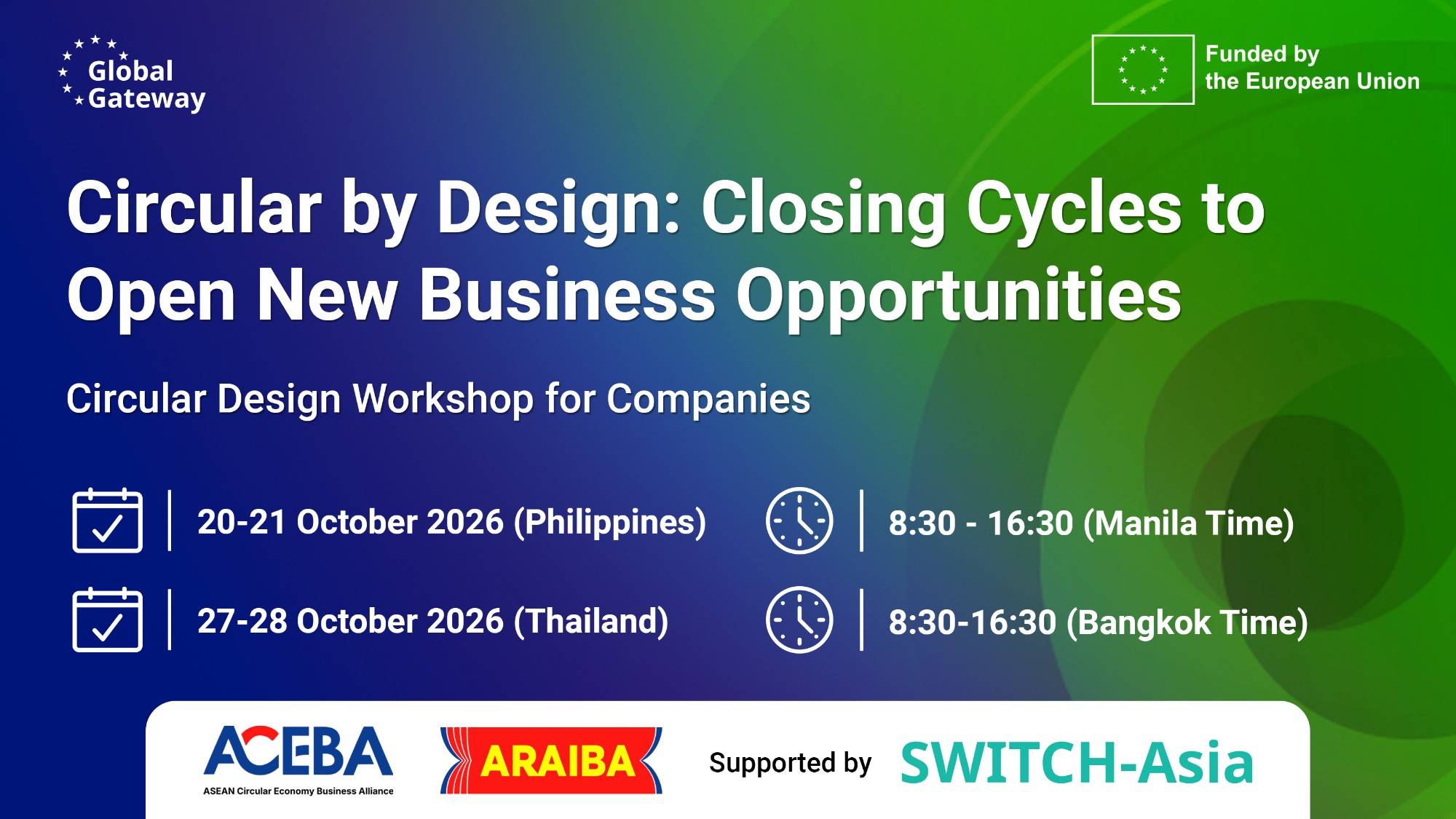
Circular by Design: Closing cycles to open new business opportunities (In-person Workshop)
20-21 October 2026, Metro Manila, Philippines (Venue TBC) | 27-28 October 2026, Bangkok, Thailand (Venue TBC)
BACKGROUND
Southeast Asia has committed to a regional circular economy (CE) transition through the 2021 ASEAN Circular Economy Framework. This is complemented by national CE and Sustainable Consumption and Production (SCP) action plans, strategies, and roadmaps across the majority of ASEAN Member States, including in Thailand through the Bio, Circular, Green (BCG) Economy framework, and in the Philippines through the National Action Plan on Sustainable Consumption and Production (SCP).
Achieving the CE-transition depends on active leadership from and implementation by businesses in developing and adopting circular products, services, and business processes that are appropriate to markets and local business conditions. Frontrunner companies across the region are already demonstrating tangible benefits, through savings on materials, energy, water, and disposal costs, and access to new markets and to sustainable finance.
The ASEAN Circular Economy Business Alliance (ACEBA) is a business-led, ASEAN-centric initiative established to foster business leadership and action on the circular economy (CE). ACEBA was launched on 22 July 2024 in Jakarta, Indonesia, with the support of the ASEAN Secretariat, the ASEAN Coordinating Committee on Micro, Small and Medium Enterprises, the ASEAN Business Advisory Council, and the European Union Delegation to ASEAN. ACEBA operates with technical advisory support from the EU SWITCH-Asia Policy Support Component.
To date, ACEBA has developed a principles-based circular economy framework for businesses and curated/ documented nearly 100 CE business cases in Cambodia, Indonesia, Lao PDR, Malaysia, Myanmar, the Philippines, Thailand, and Vietnam. These represent different sectors and business sizes, and provide practical testimony that businesses are benefitting from their circularity initiatives, in terms of operational costs savings, new product and market development, and/or improved resilience, while doing good for planet and society. Informed by these business cases, European and international best practices, and business engagements in the region, ACEBA is developing and piloting practical CE tools to support businesses, including Small and Medium Enterprises (SMEs).
In the Philippines, the Cebu Chamber of Commerce and Industry (CCCI) acts as country lead for ACEBA. ACEBA has also partnered with the Global Compact Network Philippines (GCNP) and the Design Center of the Philippines (DCP) for CE advocacy, capacity building, and knowledge development. The Thailand Environment Institute (TEI) is the ACEBA country lead in Thailand, and works closely with the Thai Business Council for Sustainable Development (TBCSD) and with the Thai Creativity and Design Centre as knowledge partner.
“Circular by Design”: A responsible business and innovation approach
ACEBA approaches CE as a responsible business and innovation strategy, with the ambition to bring both the net use of new (‘virgin’) materials and resources as well as the net disposal of ‘wasted’ materials and resources as close as possible to zero. This starts with redesigning products, activities, and business models; involves using materials more efficiently, longer, and repeatedly; and ends with recycling and recovery of wastes that have not yet been designed out. This can be achieved by adapting existing CE solutions developed and trialled elsewhere (often considered ‘quick wins’), and/or pivoting into circular solutions that are unique to a company/enterprise, building on a company/enterprise’s specific strengths, and addressing its most material CE opportunities and risks (hence potential ‘game changers’ for the company).
CE is made tangible through circular products, services, business processes, and supportive business models, putting the spotlight on systematic design as enabler for ambitious CE adoption.
At its core, circular design involves good product, service, and process design, undertaken with a circularity lens. This is promoted through a three-step approach:
● Initiate – spotlight circular opportunities by comparing current products, services, activities, and competencies with CE ambition benchmarks;
● Ideate – generate alternative circularity concepts using circular solution templates and strategies; and
● Implement – explore synergies between product, service, business activities, and business models to develop maximum value from circularity.
About the Workshop
This “Circular by Design” Workshop, co-organized by ACEBA and the Design Center of the Philippines in the Philippines and the Thai Creativity and Design Centre in Thailand, aims to work with company teams (2-3 members per company/enterprise) interested to learn more about circular design, and to get a head start in conceptualizing and developing appropriate company-specific circular solutions.
SUBMIT YOUR APPLICATION/ COMPANY INFORMATION HERE
This workshop will primarily focus on the introduction and application of circular design to a product, service and/or business activity identified by each participating company/enterprise team. This identified “circular design challenge” will be fleshed out and be the focus of the team exercises/ activities during the workshop.
The workshop is expected to result in a specific circular solution for each company/enterprise. After the workshop, debriefings with each company team will be undertaken by ACEBA and DCP to discuss follow-up steps.
TARGET PARTICIPANTS: Workshop will prioritize Small and Medium Enterprises (SMEs), with a viable product, service, business process or business line that can actually be redesigned using circular design principles. Teams from larger businesses/firms may also be considered. ACEBA is currently focusing on the following key sectors—1) textile and garment, 2) leather and footwear, 3) agri-food, 4) furniture and homeware, 5) automotive, 6) electronics and electric equipment, 7) building and construction, and 8) hospitality—but interested companies/enterprises from other sectors are also welcome to participate.
WORKSHOP OBJECTIVES:
1. Provide a design-focused introduction and overview of CE, and the opportunities and risks CE is creating for business, illustrated with wide range of business examples from Southeast Asia and beyond;
2. Introduce and practice the step-wise approach of Initiate – Ideate – Implement to generate and develop practical circularity solution concepts; and
3. Scope company specific circularity solution concepts along with potential implementation strategies for each participating company.
PROVISIONAL AGENDA/ PROGRAM (subject to change)
WORKSHOP DATES: 20-21 October 2026 (Philippines) | 27-28 October 2026 (Thailand)
|
Time |
Session |
|
DAY 1 |
|
|
08:30 – 09:00 |
Registration and networking |
|
09:00 – 09:30 |
Introduction and stage setting ● Introduction by national hosts ● EU SWITCH Asia Policy Support Component ● ASEAN Circular Economy Business Alliance ● Participants introductions – Tour de Table |
|
09:30 – 10:30 |
Circular Economy and Design: introduction ● CE concepts and practices ● CE design: products/services, business activities and business models |
|
10:30 – 10:45 |
Morning break |
|
10:45 – 11:45 |
Circular Means Business ● Doing business in a circularising world ● Business value creation – circular solution canvas ● Group exercise on analysis of circular business cases |
|
11:45 – 12:15 |
Circular by Design: overview ● Introduction, key element and approach to Initiate – Ideate – Implement ● Circular design examples |
|
12:15 – 13:15 |
Lunch break |
|
13:15 – 14:45 |
Deep Dive: Initiate ● Getting started with circular design ambitions ● Participants’ work on participant’s company’s circularity challenge ● Participants’ sharing of initiation insights |
|
14:45 – 15:00 |
Afternoon break |
|
15:00 – 16:15 |
Deep Dive: Ideate (part 1 divergence) ● Driving creativity with circularity templates ● Participants’ work on participant’s company’s circularity challenge/continued ● Participants’ sharing of ideation insights |
|
16:15 -16:30 |
Wrap up ● Synthesis and reflections on day 1 ● Outlook on day 2 |
|
DAY 2 |
|
|
08:30 – 09:00 |
Registration and networking |
|
09:00 – 10:30 |
Deep Dive: Ideate (part 2 convergence) ● Reflection on Initiate and Ideate (divergence) ● From ideas to circularity concepts ● Participants’ work on participant’s company’s circularity challenge/continued ● Participants’ sharing of ideation insights/continued |
|
10:30 – 10:45 |
Morning break |
|
10:45 – 12:15 |
Deep Dive: Implement ● Using solution canvas to develop business value ● Participants’ work on participant’s company’s circularity challenge/continued ● Participants’ sharing of implementation insights/continued |
|
12:15 – 13:15 |
Lunch break |
|
13:15 – 15:00 |
Presenting circularity solutions for action ● Introduction ● Participants’ work on action plan for company’s circularity challenge ● Participants’ sharing on action plans ● Reflections |
|
15:00 – 15:15 |
Afternoon break |
|
15:15 – 16:15 |
External reflection session (with participation of EU and country institutions) ● Moderators’ introduction ● Company reflections ● Moderators’ reflections ● Discussion with EU and country institutions |
|
16:15 – 16:30 |
Workshop closure ● Remarks on behalf of EU SWITCH Asia ● Remarks from moderators ● Next steps |
|
16:30 |
Networking and bilateral discussions |
About the Moderators
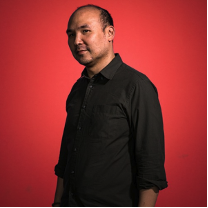 Jett Pisate Virangakapura. Jett is a design educator and social innovation consultant. He currently serves as a faculty member at the School of Global Studies, Thammasat University, where he has established the Circular Design Lab, and teaches design thinking for sustainability. He has also taught at Mahidol University, King Mongkut University of Technology, and co-taught the Design Across Borders course offered by Stanford University.
In addition to his academic career, Jett has wide practical experience in working on design projects. He has worked across the apparel, electronic, furniture, media, toy, and tourism sectors. He has played the role of a Design Thinking Facilitator and Circular Design Coach for both private and public sector organisations. His private sector clients include DTAC, MQDC, Siam Motors, and PepsiCo. His public sector clients include NESDC, OPDC, OCSC, DES, and UNDP.
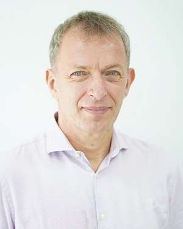 Dr. Rene Van Berkel. Rene is an international thought leader in circular economy, resource efficiency, climate innovation, and responsible business. Throughout his career he balanced roles as senior academic and international development practitioner, and advised businesses, mostly MSMEs, to improve productivity, drive environmental performance and achieve innovation. He is one of the co-convenors of ACEBA, and a senior circularity expert for the EU SWITCH-Asia Policy Support Component. He is also a member of the International Resource Panel, the leading global science to policy platform on sustainable use of material resources.
Dr. Van Berkel has held leadership roles with the United Nations Industrial Development Organization (UNIDO) in India, Indonesia, and at UNIDO Headquarters in Austria. Previously, he held a professorial position at Curtin University of Technology, Australia, and several academic positions at the University of Amsterdam, The Netherlands, where he also obtained his doctorate in Environmental Science.
Share: